

Abundance and the Art of Worldbuilding
Ezra Klein and Derek Thompson envision a once-in-a-century transformation

This is the newsletter of the Earth Action Index: a new platform to explore stories, discover ideas, and take action to shape climate futures. Before launch, we are sharing regular emails to give glimpses into the Index’s contents—including short collections, longform reflections, and project updates.

Abundance has arrived: just in time to fill the vacuum of vision among American liberals. In a moment when there are too few positive projections of the future, Ezra Klein and Derek Thompson have the courage and conviction to present one. The authors were compelled by the urgency of the climate crisis—and their book explores bold strategies to solve its most elusive challenges.
A vivid vignette of 2050 opens the introduction, featuring an ensemble cast of advanced technologies. Solar and wind combine with nuclear and geothermal energy to power homes at no cost. Vertical farms and cultivated meat factories create copious food and leave agricultural land to rewild. Desalination plants make salt water drinkable. Automated factories in low orbit produce miracle medicines, delivered to your house via drone. In this future, there is no crisis of climate nor affordability—Americans have more than enough housing, energy, transportation, innovation, and healthcare. This is the world that Klein and Thompson are working towards.
Rarely do we encounter this kind of imagination among the factuality of news and presentism of politics. Worldbuilding is a technique usually reserved for filmmakers, game designers, and speculative writers. Alex McDowell, production designer of Minority Report and director of the World Building Institute at USC, defines its promise: “Imagining or portraying something that doesn’t yet exist in the world is a way to enable it to exist.” In McDowell’s practice, the goal is to create future reality—not science fiction. He approaches worldbuilding by surveying the nascent technologies of the present, and imagining how those seeds might sprout in the future. At their best, richly detailed stories can have a feedback loop to reality:
“If we were able to tell a convincing story that would immerse an audience in a completely different kind of outcome, then we could thread that back into the present; we could discover the steps we would have to take to push toward that direction.” — Alex McDowell (Future of StoryTelling film)
In their more-than-enough manifesto for the future, Klein and Thompson apply the work of worldbuilding to the practice of politics. What Abundance does—that no science fiction storyteller would ever dare—is propose a policy pathway to build the world they imagine. The authors believe that only government can create the conditions for this abundant future to exist. Political participation is paramount. In this piece, I’ll briefly explore four dimensions of the book and what room it leaves for us to co-create the world they envision.
1. We need a liberalism that builds: strive for outcomes and remove bottlenecks.
The thesis of Abundance is simple: “To have the future we want, we need to build more of what we need.” So what’s standing in the way? Most of the book investigates the long history of government regulation and burdensome bureaucracy that have stymied progress—in blue states, especially.
The problem we faced in the 1970s was that we were building too much and too heedlessly. The problem we face in the 2020s is that we are building too little and we are too often paralyzed by process.
The liberalism that once built highways, cities, and space programs has been replaced by a liberalism that disassembles, delays, and second-guesses (see: California High Speed Rail). Klein and Thompson position Abundance as a new bipartisan political order, one that reorients politics toward shared outcomes and a fundamental question: “Can we solve our problems with supply?”

2. Clean energy abundance is the prerequisite for all societal progress.
The book left me with a core conviction that clean energy is not a separate sector or environmental agenda item; our means to meet the climate crisis are the same efforts that will energize the economy, improve human health, and increase innovation. This is a critical reframe:
It is an all-purpose national affordability policy and an innovation policy. Simply put, energy abundance might be the single most important technological bottleneck of our time.
The world installed more solar power in 2023 than it did between 1954 and 2017—yet we are still nowhere close to meeting baseload demand. Achieving even a middle-road climate scenario would require building “two 400 MW solar facilities every week for the next 30 years.” This is the work of rebuilding our world.

3. It’s time for a new era of environmentalism, shifting priorities from conservation and regulation to implementation.
Klein and Thompson offer a sobering rebuttal to cautious NIMBYs and degrowth liberals: “Either we build faster or we accept catastrophe. There is no third option.” While the doctrines of conservation and regulation remain relevant, this era requires a new priority. Let’s call it implementation—a favorite word of the authors and Ayana Elizabeth Johnson alike—where progress is measured by what gets built rather than what gets blocked. The task of implementation is shared among the public and private sector, and extends to individuals too:
“In the next few years consumers will need to replace about one billion machines with clean alternatives…. Electric cars accelerate faster and run quieter than cars powered by combustion engines. Induction stoves boil water in a fraction of the time it takes those little licks of fire. These advantages are not universally known—and because new technologies are more expensive than mature ones—subsidies need to be generous, and advertising needs to be everywhere.”
Electrifying our homes with heat pumps, induction stoves, community solar and more—in other words, decarbonizing your life—is an key part of co-creating an abundant future. Here is a great resource from Rewiring America:

4. Government is essential to scale solutions and invent technology, but only if we renew our institutions.
Klein and Thompson offer a refreshing (read: surprising) level of confidence in government’s ability to solve big problems and take risks. For all of the their criticism of government regulation and liberal proceduralism, the authors extoll the virtues of “state capacity” at its best: Operation Warp Speed scaling a nascent mRNA COVID vaccine in ten months; DARPA inventing the internet, the personal computer, GPS, and more; Josh Shapiro’s I-95 rebuild taking twelve days instead of five months.
Government is capable of addressing the climate catastrophe and affordability crisis, if we embrace the project of renewing our institutions—instead of tearing them down.
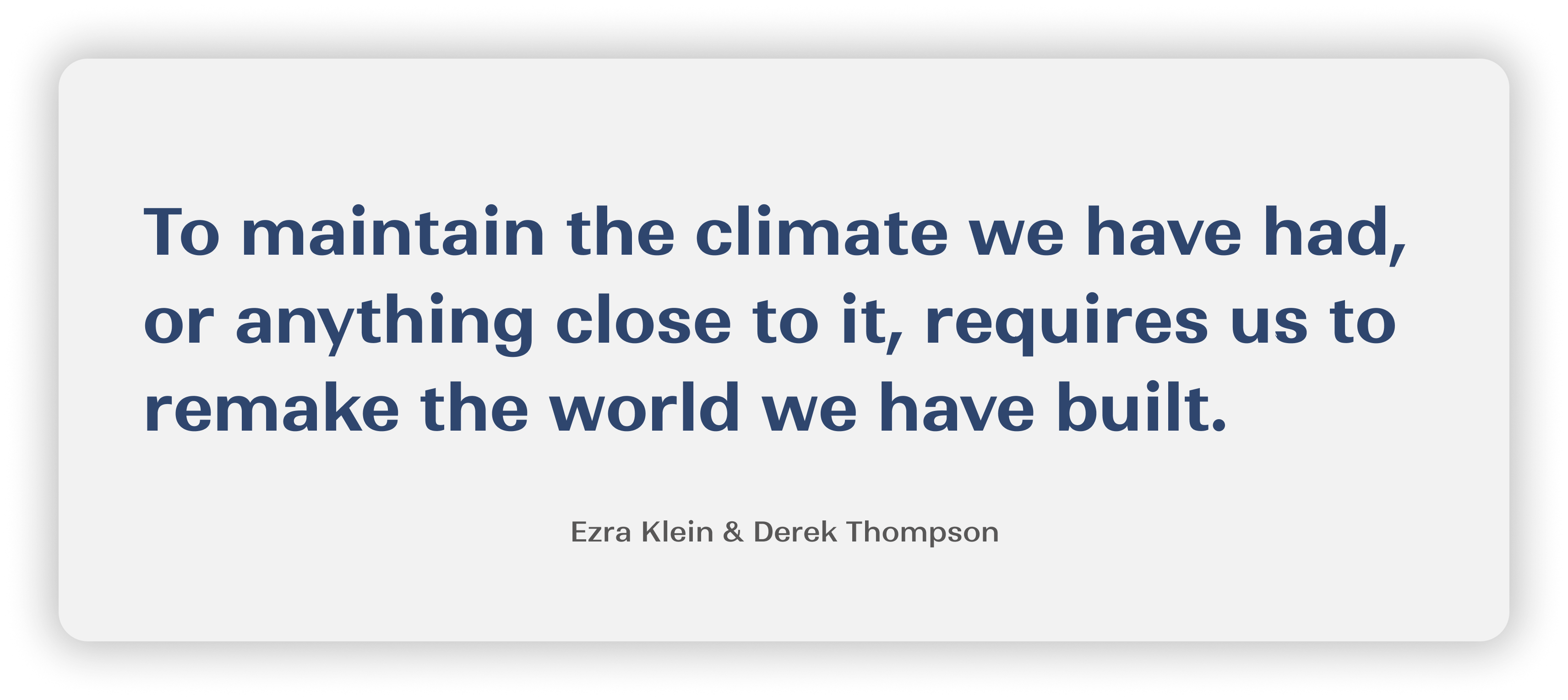
Now the government has taken on the task of decarbonization and the responsibility of coordinating a once-in-a-century transformation of America's built landscape. But it is doing so with laws and agencies and habits that are better designed to block green construction than to allow it.
It’s unclear which politicians will rise to take the Abundance mission statement and transform it into a policy agenda and a cohesive political message. On the energy front, look to local leaders. As climate scientist Zeke Haufather told the New York Times: “Energy is actually, in many ways, much more of a state issue… A lot of what gets built and when it gets built is up to state governments and local public utility commissions.” Look out for leaders who speak of an abundant future—maybe they will have the courage to build it.

Appreciate your attention! This is only a glimpse into Abundance—much more to be said—I suggest finding the authors on one of your favorite podcasts. Keeping tabs on this ongoing conversation and will share more entry points for action as they arise.
More soon,
Michael