

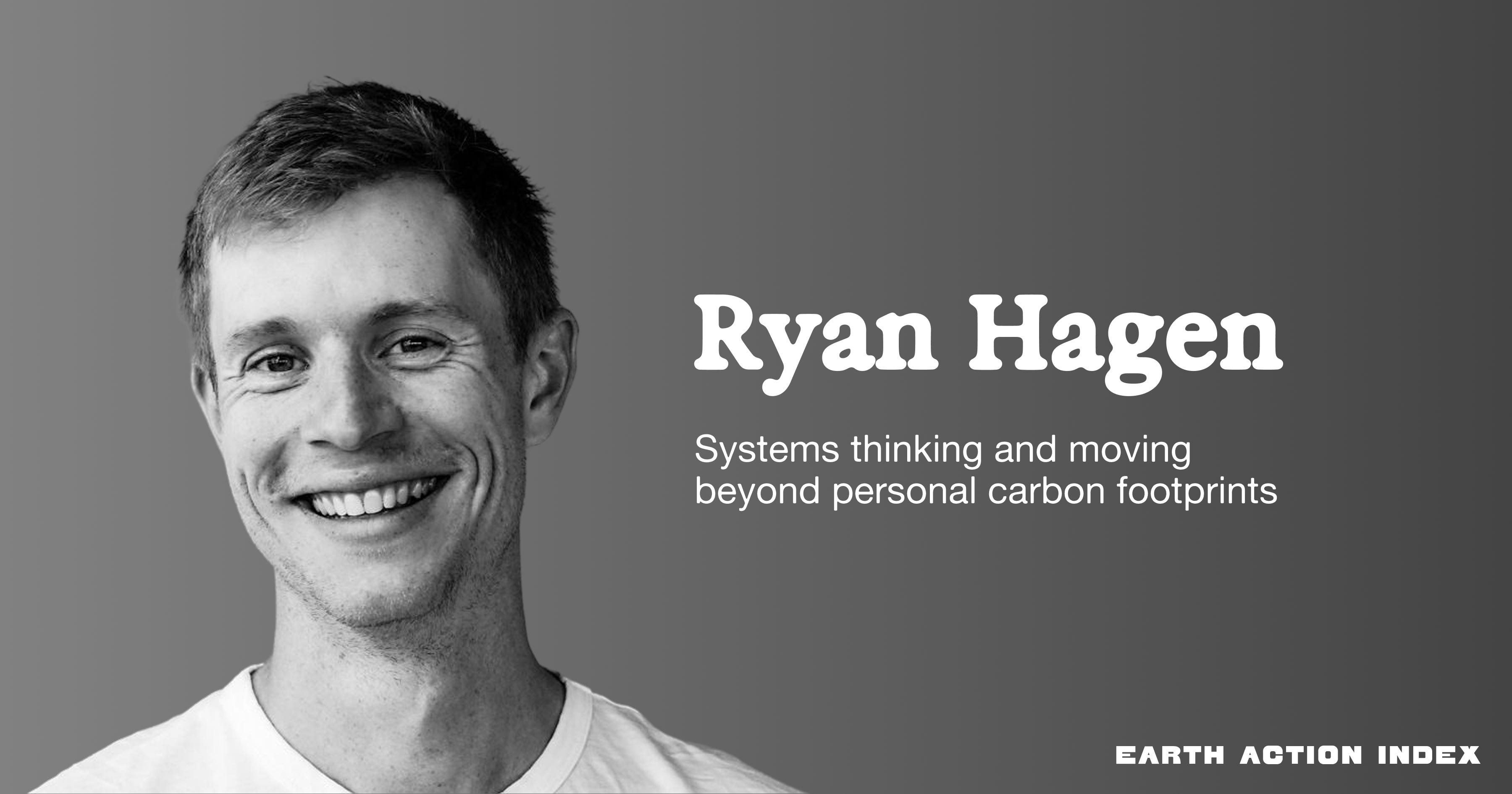
Ryan Hagen on systems thinking and moving beyond personal carbon footprints
The Burlington-based writer joins us for our first audio interview

This is the newsletter of the Earth Action Index: a discovery platform for nature connection and climate solutions. Today, we’re experimenting with something new: an audio interview.
Personal carbon footprints have long dominated climate discourse. How do we move beyond this limiting framework and direct our energy to changing systems? Ryan Hagen has been exploring this question for more than a decade. In 2018, he started a climate action newsletter that grew to reach 200,000+ subscribers, alongside his nonprofit Crowdsourcing Sustainability. His work has been recognized by the UN, TEDx, and LinkedIn as a top voice on the green economy. He recently released his first book: Your Guide to Climate Action: How to Move Beyond Your Footprint and Make a Big Impact. These days, he lives in Burlington, Vermont.
In his book, Ryan writes that the most important individual action in the face of climate crisis is to talk about it. He has a gift for doing just that. I felt the best medium for this message would be a live conversation, which we recorded and you can listen to here. Our conversation ranges from impacting “mid-level systems” and “multisolving” to climate dance parties and the sunsets over Lake Champlain.
This is our first go at an audio interview. If you listen and feel called to offer your feedback, please drop me a note.
Listen here - link will open in your browser. Highlights from the conversation transcribed below, edited for length and clarity. Hear the full context in audio.
MB: The subtitle of your book is How to Move Beyond Your Footprint and Make a Big Impact — which reminds me of Katharine Hayhoe’s idea that the most important thing you can do for climate action has nothing to do with your carbon footprint. Why is “beyond your footprint” the message people need to hear right now?
RH: The first thing that comes to my mind is another quote, from Bill McKibben — he says something along the lines of, the most important thing an individual can do right now is be less of an individual. And that’s the same idea.
I made it the subtitle of the book for multiple reasons. One of them is because I think we really are at a point in time where we need to do that. We need to move beyond our footprints. We need to change these bigger systems we're a part of. There are studies out there that say, if we only worked on our footprints, we could reduce emissions by like 20 to 35 percent, something like that, which is significant. But that’s still less than half of what we need to do. And if that’s all we ever do, we’re going to fail miserably at solving this problem…
… There’s been a lot of disinformation and misinformation campaigns to get people to continue thinking about environmental issues as a personal footprint problem. And so I just think it’s really important to kind of call it out — I’m not saying those actions aren’t important, because they are — but it’s really important that we also start thinking beyond them. What are the other levers of power, and how can we act together to change these mid-level systems that we all belong to, like our schools and our towns, our states, our companies? Because that’s where the real leverage is and where the real change is going to happen.
MB: You started your climate journey in 2013 when the carbon footprint conversation was still really dominant, famously spread by fossil fuel companies to keep us focused on individual behavior. What do you think is changing in the culture where there’s an opening to propose and drive forward ideas about systems change?
RH: It's a good question. My mind goes to just the urgency of the issue. If the world had started taking action back when I was born in 1991, when the first Conference of the Parties (the climate COP) had just happened, maybe we could have nudged our way to getting emissions to zero. But instead of flattening out emissions around then and going down, annual emissions have gone up by about two-thirds — about 67 percent — since that time. They might be flattening right now, or soon in the next handful of years hopefully. But they haven’t yet, and the problem has gotten worse and worse and worse… And I think because of the timeline of how little time we have left to change everything, there’s kind of that forcing function of we can’t just play around with the margins anymore. We need dramatic transformation of how things in society work and how the economy works.
MB: I’m curious about your own self-education about systems thinking — were there books you read, or people you looked to for wisdom, that informed your thinking about how systems work and how they can be changed?
RH: A few things are coming to mind. One is that since maybe the second half of college, I've just been a very curious person. Endlessly curious about the stuff that interests me, wanting to understand it at the root level. Always asking why multiple times and trying to figure out how things actually work. And then once you start caring about climate change, you realize climate touches everything…
… In terms of who I read on systems thinking: Donella Meadows has a book, Thinking in Systems. And then someone who learned from her — who I quote in the book multiple times — is Dr. Beth Sawin. She learned from Donella Meadows and has her own book and her own work. I think both of them are brilliant thinkers in that space. There’s also the famous Limits to Growth, which is still on my reading list… It’s a really important framework for us to consider more frequently, because we are all part of these systems and they’re all interconnected, and what we do impacts them. It’s easy to feel overwhelmed and small and like you can’t change anything. But we’re all part of these systems and we all inherently have some power within them.
MB: When you were building a theory of change around climate, which systems feel like the ones most within our influence?
RH: I think it’s going to be different for different people. That’s where someone kind of needs to sit down, probably with pen and paper, list out those systems you’re a part of, and think through: who are the decision makers in these places? Do I know them? Do I have a relationship with any of them? Which of these places do I have the most relationships in? Which of these places do I spend the most time, or which ones make me the happiest or give me the most energy? Asking all those questions, you can start to better understand where to focus your limited time and energy, because it's going to be hard to change all of them…
… If you're trying to figure out the potential for impact, it's going to take a little time. Start by looking through the list of systems you're a part of. Let’s start with the town or city that you’re a part of: that one might actually have the work done already for you. You can go online and type in your town’s name and then “greenhouse gas emissions” or “climate action plan.” Either way, there’s a tool called Crosswalk Labs. You can just type in your town or your city, and it’s going to tell you the probably hundreds of thousands of tons of emissions coming from your town every year, or in the millions if you’re in a bigger city. You can start asking these questions and even guessing if the answer is not out there, just to relatively size up the opportunity for impact in these different spheres. And combining that potential impact you could have with the power and relationships you have in each of these places — that’s the stuff to start pondering when you’re figuring out where you want to plug in and take action.
MB: Could you introduce us to multisolving — what it means and how it applies to communicating about climate?
RH: Multi-solving is when you take one investment of time, energy, or money — one action — that’s going to result in multiple positive benefits. I think the best way to learn about this is to go read Beth Sawin’s book called Multisolving, or check out her nonprofit, the Multisolving Institute, because she literally coined this word.
The idea is that instead of an action just reducing emissions and addressing climate change, it’s also doing things that are going to benefit your community in the present day. If you focus on building out more bike lanes, that is going to not only reduce emissions because it gives people an opportunity to bike instead of drive — it’s also going to make people in your town healthier because they’re exercising more, it’s going to reduce healthcare costs, it’s probably going to make people more productive at work, and bike lanes also help local businesses. It’s all these co-benefits, these kind of like second, third order effects of one action that you might not immediately think of, that make this one investment really worthwhile…
… And it’s also really powerful for organizing, because some people are going to care a lot about climate change, and others might care a little, but it’s not going to be their main thing, and others might not care at all — but a lot of people are going to care about all those other things we just talked about. Depending on who you’re talking to, you can focus on the positive co-benefit they really care about. That can be their reason to get behind the thing. And that’s great. Everyone still wins.
MB: I’m interested in how you determined the ten actions to include in the book, and why you put them in the order you did. What are the top three most effective actions in the book, and why did you lead with those three?
RH: So they’re not really ranked. “Talk about it” is first because I think it’s the most fundamental. So if there were to be a number one it would probably be that. Just because you need it for all the rest, pretty much for all the system stuff. And when you talk to people about it, it has the ripple effect of, you know, we’re a social species and once they realize you care about it, they’re more likely to care about it. If you're talking about the actions you're taking, they're more likely to join you, especially if you ask them kindly. And to get the people power we need to influence decision makers and get decisions made in a climate-positive way, we need to be able to talk to other people and organize and find common ground and build relationships with each other. This change-making is really about building relationships…
… The next four or five are kind of lumped together. Chapters ten, and eleven are about electing climate champions and helping make your town or city climate-positive. I put those together because they are local civic engagement, being part of your community, part of your state, helping change those systems and getting your representatives to take action. The next two are helping make your company climate-positive and getting a job in climate — both really impactful. And then the one after that is how to help make your schools climate-positive. Those five are all lumped together because I see those as the juiciest mid-level systems…
… After that I get into reducing your footprint — which is good and worth doing… Making your money climate-positive, which is honestly the one people have brought up the most. I think because it’s not thought of as frequently, and it can be quite powerful in a subtle way. And then the last one is the activism chapter, about civil resistance and peaceful protest… There’s also donating to impactful nonprofits.
MB: What do you feel are the invitations for people who feel time-bound or limited in their capacity to engage in high-friction systems change?
RH: Yeah, that’s real. We’re all really busy. I would recommend — and this is actually at the very start of Part 3, on finding your place in the movement — there’s a Venn diagram by Dr. Ayana Elizabeth Johnson. I’d recommend people fill out that diagram to find what their specific climate action might be that’s most aligned with them. You draw three circles and answer three questions: What brings you joy? What are you good at? And what’s the work that the world needs doing?
Doing that, you start to get a sense for which action or which direction is most aligned with who you are and what you’re going to be energized by and actually do… And then just try whichever ones on that list feel like they resonated or you were curious about.
The list is a menu of actions. It’s not “do all these things.” It’s find the thing you want to try first and see how it goes. In terms of time, just start small. If you only got an hour a week, start with an hour and commit to doing that over and over. As you start to make progress, you can build it up. And my other thought is: this isn’t true for everyone, but from the data, we’re all glued to our screens way more than we should be, myself included. And if we feel like we have no time, it might be worth first thinking through what we can cut out that we don’t actually care about and that isn’t benefiting our lives.
MB: I honestly struggle with this tension of slowness and urgency in this work. Being in the living world, being in nature, we’re invited to slow down, see things on longer timescales. Deep time. There are huge benefits to taking the long view. At the same time, the problem is so urgent and we need to make transformations instantly. How does that manifest for you after your years doing this work?
RH: I think it comes down to moving as quickly as we can while taking care of ourselves. That means we're probably not going to move as fast as we want to. But not letting that stop us from continuing forward… It comes down to doing our best, taking care of ourselves, living a good life, and trying not to burn out — because I did. When I was doing Crowdsourcing Sustainability, I shut it down after five or six years. There were a few reasons: Part of it was financial, but part of it was also that I burnt out. And if you burn out… you want to be able to keep going; you want to be able to keep doing the work. This is a marathon. It feels like a sprint, and we have to finish the marathon as quickly as we can. But we’re going to be doing this work for decades. It’s going to take a while to get to zero emissions globally, and then still we’re going to have to deal with the impacts of that way hotter world. So we’ll have to keep building resiliency, repairing and restoring ecosystems, figuring out new ways to draw down carbon from the atmosphere to get our temperature back to where it's safer…
… When you take care of yourself, live well, and make sure you have good energy, joy and laughter — that also makes things happen faster. If you’re in a movement that has music and dance and joy, more people join that movement… It’s awesome just because it’s more fun. But it’s also going to make you more effective at whatever you’re trying to do.
MB: You mentioned Dr. Johnson and her Venn diagram, which was also a huge inspiration for me. The paperback version of her book is coming out. I don’t know if you saw this: she’s doing climate dance parties around the country, like the Monterey Bay Aquarium and the Brooklyn Botanical Garden. It’s probably the coolest and purest manifestation of that idea of making this movement fun.
RH: Shout out to Ayana — if she ever hears this, come up to Burlington. You’ll get a big showing for the dance party.
You can keep up with Ryan’s work on his Substack, website, or check out his book. Soon, you’ll be able to find Ryan’s recommendations on the Earth Action Index platform. Stay tuned ~