

Spring update: Building tools to bridge story and action
Reflections on the first three months of building the Index

Ideas only become clear when you start to bring them to life.
This week marks a milestone for the Earth Action Index: the conclusion of three months of learning at the Climatebase Fellowship and creating our first working prototypes.
This Spring, the seed of the Index idea has bloomed quickly—in unexpected ways. We built tools that transform any climate story into an interactive experience.
One prototype tool is a browser extension. You can activate it on any story or website related to climate or ecology. The Index understands the content of the site and intelligently offers connected actions from our curated database. Every story becomes a trailhead: a starting point that leads to branching pathways to participate.
Today, sharing the story of how we got there—and a preview of where we are going. Thank you to the collaborators, advisors, and friends who have contributed so far. We made more progress this season than I could have imagined:
Surveying the solutions landscape with Climatebase.
Refining a focused mission for the project.
Building prototype tools that bridge story and action.
Next: Growing the Index and inviting user testing & feedback.
1. Surveying the solutions landscape with Climatebase.
The Climatebase Fellowship was a tour of the topography of the climate movement: the peaks of success stories, the valleys of persistent challenges, and the solutions still on the horizon.
Exploring biochar and mangrove forests, regenerative agriculture and heat pumps, it became clear that climate solutions only scale for their co-benefits: the reduction in cost of living, the restoration of biodiversity, the promise of healthier and safer communities. As Buckminster Fuller wrote:
“You never change things by fighting the existing reality. To change something, build a new model that makes the existing model obsolete.”
Across the movement, people are proving that their solutions are simply better (and sometimes cheaper) than the incumbent alternatives. We met a community of individuals who are approaching solutions from every angle imaginable, and filled the Index database with our learnings. A group of fellows from Climatebase joined our team as contributing editors, tasked with researching relevant stories & actions.
Highlights included guest speakers like Jonathan Foley (CEO of Project Drawdown) and Jigar Shah (fmr. Director of Loans Program Office at the Department of Energy). The best sessions were hosted by imaginative pragmatists: people who are steadfastly implementing solutions and insisting that a better future is within reach.
2. Refining a focused mission for the project.
In March, the pitch deck for the Index was 45 slides. In June, it is only 5. Building something is a challenge of reduction, not addition: whittling ideas to their fundamental function.
The Earth Action Index is a bridge from story to action. We amplify solutions and make stories interactive: transforming passivity into participation in the movement.
At Climatebase, the entrepreneurship refrain was: “Get obsessed with a problem, not attached to a solution.” I have been occupied with the same problem for 10 years. Our conventional media does not offer meaningful pathways to interact with stories—or to affect the outcome. Disempowerment is dominant. We can’t help but feel helpless.
The story of the planetary crisis is not one to be passively consumed, scrolled past, or skimmed by. Overwhelmingly, people want to be a part of the solution. 62% of Americans say they feel a personal sense of responsibility to help reduce global warming (Yale 2024). It’s not the job of journalists to connect stories with actions that individuals can take and collective efforts they can join—but it is ours.
The Index bridges the gap: when we finish reading the news or watching a film and think “What can I do?,” the tool instantly offers you invitations. It is this moment of emotion when we need a menu of options to channel our energy into deeper attention and collective action.
3. Building prototype tools to connect story and action.
I read a fascinating longform New Yorker story about the potential of geothermal energy. Now what? How is this enormous effort relevant to me as an individual? What are the branching pathways of attention and action that emerge from this trailhead?
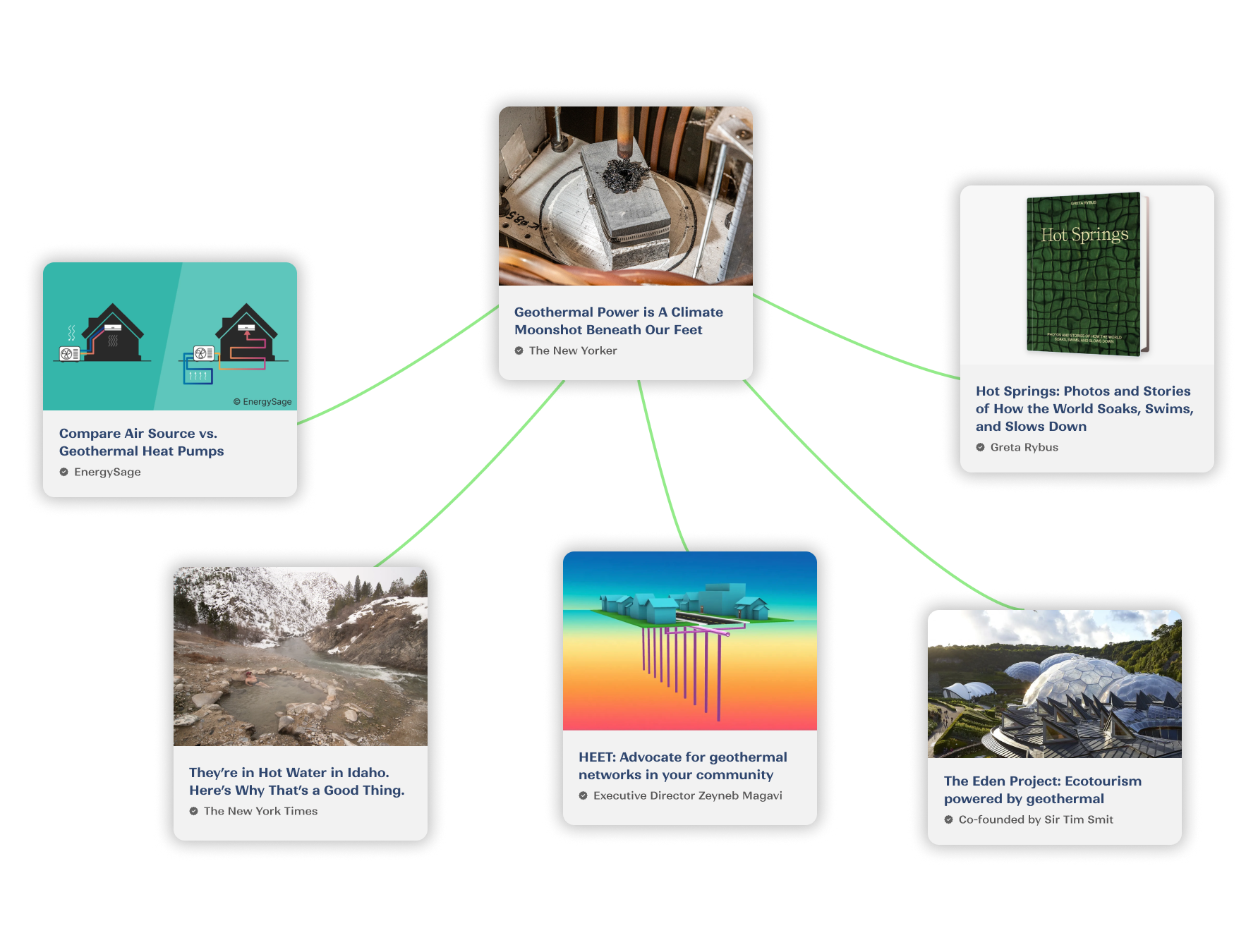
We have created two working tools to help answer this question. The first is a Chrome extension (the Index “to go”) and the second is a web platform (the Index “to stay”).
Extension: A flexible tool that you can activate on any piece of climate or ecology media you find online. With the click of a button, the Index understands the content of the site and then searches our curated database for the most relevant actions: a community to join, an active petition to sign, a book to go deeper, a film to understand it visually. Our editors research and map these “constellations” of actions, populating the database and improving the tool as an intelligent companion for reading the news.
Platform: A digital “bookstore” full of stories of solutions, tools to take action, and ideas for a better future. Wander through the sections of the Index to discover entries that inspire and invite action. Every entry is a node in an interconnected network: opening a story about fire-proof architecture or a book about the new science of plant intelligence leads to a rabbit hole of connected entries. The extension pulls from the stories, tools, and actions that live persistently on the platform.
Now we are preparing to share these tools for testing by this community soon.
4. Next: Growing the Index and inviting user testing & feedback.
The quality of our tools hinges on the quality of our curation. In this next phase, we are growing our team of contributing editors who bring their expertise and curiosity to the project. The critical thinking of curating stories & actions is not a LLM-able task: it’s something that requires combinatorial creativity, rigorous research, and trust.
If you or anyone you know might be interested in joining us as a contributing editor (lightweight part-time engagement), please reply here.
This Summer, we are refining on our prototypes with an eye towards inviting the feedback of initial user testers in the coming weeks. Stay tuned for updates here.
Thank you for your attention and support so far. We’re just getting started.
Seeing Buckminster Fuller, Stewart Brand, Bill McKibben, Mary Oliver, Charles and Ray Eames, and Ezra Klein all in one place brings me joy!
Woooooah you built the browser extension already? Nice!