

The field guide of the future
Now available near you or for holiday travels


This is the newsletter of the Earth Action Index: a discovery platform for climate and ecology. This week, sharing a project update to close out the year.
Dear Earthlings,
This season, we’ve been zoomed into place.
In conversations with many of you, the same wish kept surfacing: to connect more deeply with your places. In distracted digital times, there is a cultural craving for presence and engagement with our immediate surroundings. What can we do here?
Now, the Index can help you participate in place. We’ve been calling this collection of tools “the field guide of the future.” It’s been a joy to watch our early birds test these tools from Sydney and Mumbai to New York and Raleigh - and see their home places through a new lens. You can explore your place, where you might be traveling for the holidays, or anywhere that sparks your curiosity:
Thank you for every conversation, vision shared, and feedback offered in 2025. Appreciate you and sending great energy for the year ahead ~
Placefulness vs. placelessness
For so many of us, exploring a place evokes a childlike sense of wonder. A flash of standing small beside your parent in the park, learning: acorn, robin, cardinal, dew, cumulus. The simple act of noticing and attending to something outside of us.
But the architecture of adult, online life often stands between us and this timeless joy. The information ecosystems we spend our time swimming in are global, incessant, and overstimulating. Content appears out of context. This leaves the places we inhabit to fall out of view. Today’s technologies make us think and scroll globally - but very few of them help us engage and act locally.
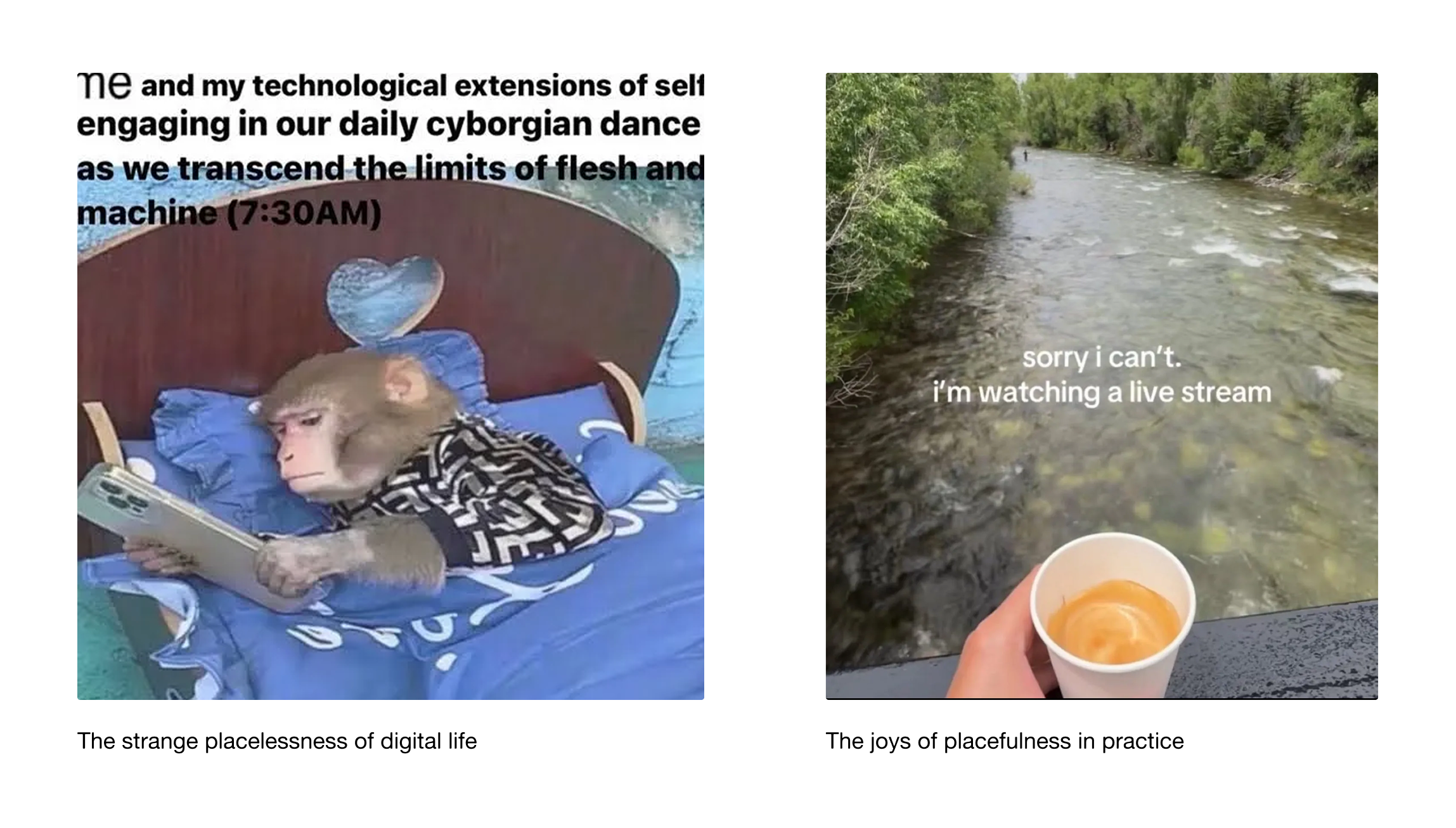
The Index is our attempt at an alternative: refusing the situation we have been designed into. In the spirit of Jenny Odell’s writing: we “refus[e] to believe that the present time and place, and the people who are here with us, are somehow not enough.” Against the placelessness of online life, Jenny argues for placefulness: an attentive engagement and participation in our surroundings.
Placefulness is a feeling. A sense of connection to the here and now. Aware of the light changing, the plants blooming, the migrations unfolding. Tuned into the community happenings in the area this weekend. Familiar with the depth of history that unfolded here and the questions that are shaping its future. It’s a feeling that starts as attention and grows into devotion.
We are working on tools for placefulness. Building a kind of information ecosystem that invites us to connect with the living ecosystems we inhabit. Rather than “living in the news,” with feeds that pull us up and out of place, we come wielding technology that pulls us back downward into the neighborhoods where we live our lives.
2025 is a moment when technology and nature are often considered in stark opposition - especially in the AI discourse. For good reason. But there is nuance and potential for alternative futures here. As David Gruber, featured our recent Project CETI piece, shared in the NYT:
“What I’ve come to know is that technology and nature do not exist in a zero-sum universe where the ascendance of one side is the downfall of the other. Instead, these tools can give humans an opportunity to feel more tethered to the flora and fauna that surround us.”
As AI innovation races along, it’s a critical mission to pursue alternative potentials of the technology. To create a counterweight against the models that will only further disconnect us from nature. The newest features in the Index use technology - powered by open-source citizen science, AI web search, and human recommendations - to connect us more deeply to the living world.
Experiments in placeful technology
Today, maps are a familiar model of technology that tethers us to Earth. But most of the maps we interact with are funhouse mirrors of the human world: street names, property lines, and so on. Traces of the more-than-human have been scrubbed or subdued: the plants and creatures present, the geology that shapes our landscapes.
What does technology that reconnects us with the living world look and feel like? Tools that helps us not only perceive what’s happening in our place, but participate within it? We are experimenting with a few different ways to connect with place:
Field guide: Open a hyperlocal guide to the plants, creatures, and fungi present in the current (micro)season of your place. It will refresh as the world around you does.
Seasonal foods: Check a grocery list for your in-season foods here and now, alongside the best seeds to be planted at this point in the year.
Communities to join: Join and support existing community efforts to protect, beautify, and advocate for your place.
Deep time: Expand your view to the scale of hundreds of millions of years, to see the ancient seas or mountain ranges that shaped the land.
And more to come ~
Last week, I checked the field guide before a walk in Prospect Park, and read that I might see white-throated sparrows, northern cardinals, and red-tailed hawks particularly active this week. Lo and behold, within a few miles, I spotted all three species paused to perch on bare branches.
It’s time for technology that invites our attention back to the places we inhabit. They are calling out for our care and participation like never before. The future must be placeful.